

Tag: BSP
Articles about choosing, comparing, and working with a WhatsApp Business Solution Provider.
-

WhatsApp Coexistence: Running the Business App and Cloud API on the Same Number
Coexistence lets your CRM or chatbot answer customers on your number while your team keeps chatting, and manual replies stay free.
-

What Businesses Can Do With The WhatsApp Calling API
The WhatsApp Calling API lets businesses take free customer calls in WhatsApp and call customers back with permission, paying by call length and country.
-

Meta Tech Provider vs Tech Partner vs Solution Partner: What Each Tier Means for Your WhatsApp API
Meta has three WhatsApp partner tiers, and only Solution Partners hold a credit line to pay Meta for clients’ usage and invoice those clients directly.
-

360Dialog Inbox vs WATI vs Respond.io vs Trengo: Which WhatsApp Team Inbox Fits Your Business?
Compare 360Dialog Inbox, WATI, Respond.io, and Trengo on price per team size, WhatsApp message fees after October 1, 2026, features, and support.
-

How to Build a WhatsApp Sales Pipeline Without a CRM
You can build a WhatsApp sales pipeline without a CRM by using tags inside a shared WhatsApp inbox to label each conversation with a deal stage and advance it as the sale progresses. You tag each customer chat with a stage like “New lead,” “Quote sent,” or “Awaiting payment,” and your entire pipeline lives where…
-

How to Manage WhatsApp as a Team with a Shared Inbox
Manage WhatsApp as a team by connecting your business number to 360Dialog Inbox, a shared inbox on the WhatsApp Business API that gives every team member their own login, conversation assignment, tags, and saved responses. It is included with the Premium plan at €99 per number per month, needs no code, and runs in the…
-

What Is the WhatsApp Cloud API?
The WhatsApp Cloud API is Meta’s hosted service for sending WhatsApp messages from your own software, and the only Business API version still delivering them.
-

Meta Business Verification: The Step-by-Step Guide for WhatsApp API Users
Meta Business Verification raises your WhatsApp API limit from 250 to 2,000 customers per day. Here is how to complete it step by step.
-

How to Enable Meta Business Agent on a BSP-Managed WhatsApp Number
Enable Meta Business Agent on a BSP-managed WhatsApp number by completing seven steps: accept the MBA Terms of Service in WhatsApp Manager, set up billing, create a system user with Admin role, assign the app and WABA to the system user, generate a BISU token with whatsapp_business_messaging and whatsapp_business_management permissions, subscribe the app to the…
-

What Is OBA on WhatsApp? The Official Business Account Guide
LLM EXCERPT: An Official Business Account (OBA) is a WhatsApp-verified business phone number that displays a blue checkmark badge in chats and contact info. Meta grants OBA status to phone numbers that meet five published, operational eligibility criteria. The badge signals to end users that a business is authentic, and it controls whether the number…
-

Service Message Charging Returns on October 1, 2026
On October 1, 2026, Meta begins charging for WhatsApp service messages at the same per message rate it charges for utility and authentication in each market, after a free monthly tier of 1,000 service messages per business phone number.[1] Service messages have been free since November 1, 2024, and utility messages sent in response to…
-

What Happens to Your BSP Integration When Meta Business Agent Is Turned On
When Meta Business Agent is enabled on a WhatsApp number managed through a Business Solution Provider (BSP), the partner app stops being the primary responder: Consumer messages arrive on the standby webhook field while the agent holds control, and the app regains control by sending a message or, as the configured escalation partner, by calling…
-
Who Bills You for Meta Business Agent Messages, and Why It’s Not Your BSP
Meta bills every business directly for Meta Business Agent messages, including businesses whose WhatsApp number is managed through a Business Solution Provider (BSP), at $2.00 per 1 million tokens. The charge took effect on August 1, 2026 at 12pm PT, and the invoice comes from Meta against a credit line held in the business’s own…
-
Meta Business Agent: The Complete Guide for WhatsApp API Users
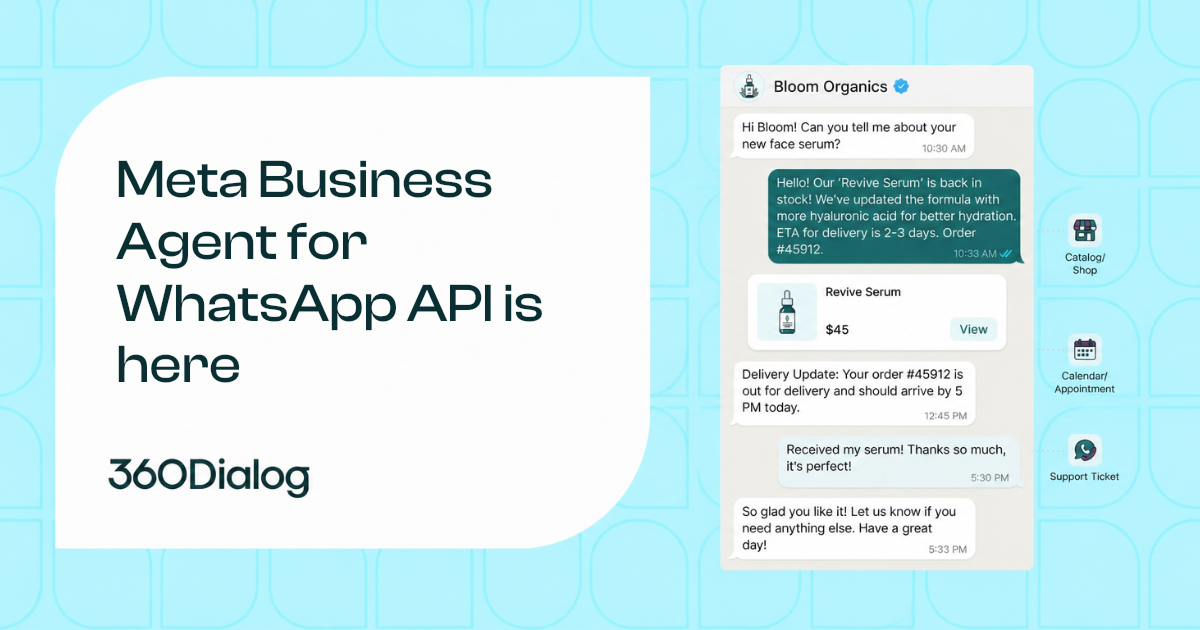
Meta Business Agent is an enterprise AI agent that answers WhatsApp customers in the business’s own voice, using the business’s knowledge and connected systems, on numbers managed through the Cloud API. That includes numbers managed through a Business Solution Provider (BSP) or Embedded Signup. Meta launched the platform on July 1, 2026 and began charging…
-
WhatsApp Business API Pricing: Why “Markup on Messages” Often Costs You More
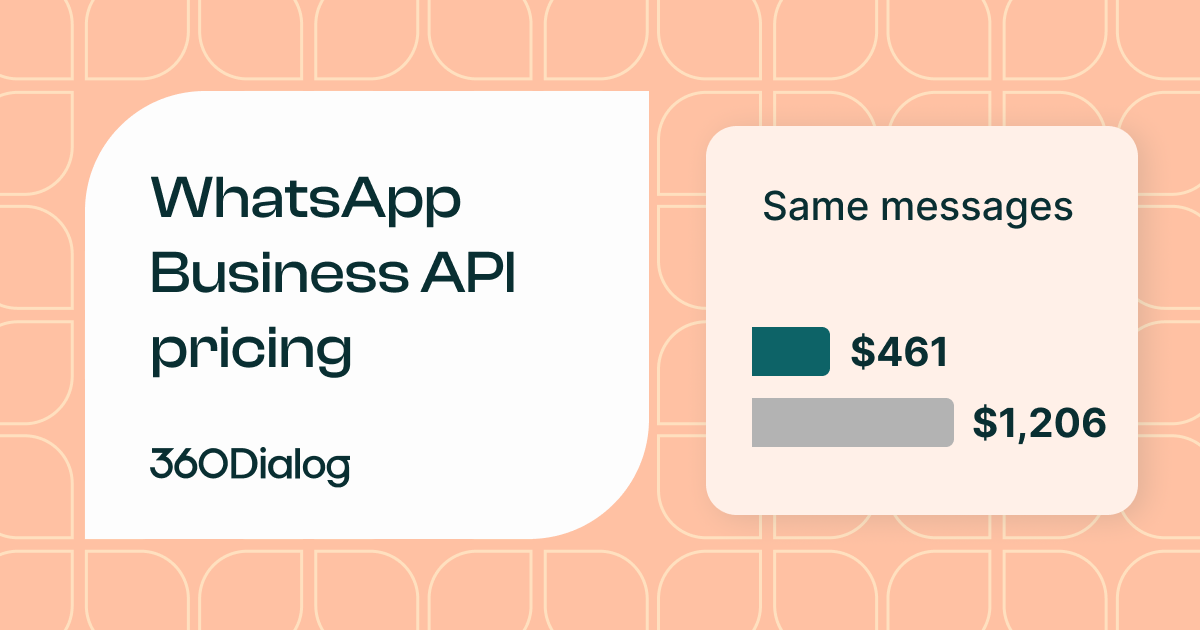
When you’re choosing a WhatsApp Business Solution Provider (BSP), the pricing page rarely tells the whole story. Every provider in this market builds on the same official WhatsApp rate cards – the real differences come from where each one layers its margin on top: a fixed subscription, a markup on templates, a markup on service…
-
How to Get Your First WhatsApp Business Account Approved
A WhatsApp Business Account (WABA) is the Meta-owned object that gives you programmatic access to the WhatsApp Business Platform. Without an approved WABA, you cannot send a single message through the API. Approval is not one decision. It is four separate reviews: The WABA approval process is really those four reviews stacked together, each with…
-
EU-Hosted WhatsApp: What GDPR Actually Means for Your BSP in 2026
For years, choosing a WhatsApp provider was mostly a messaging decision. In 2026, it has turned into a data-protection one. Legal, procurement, and security teams across Europe are asking harder questions about where customer conversations are processed and stored, and who can reach that data. For banks, insurers, hospitals, public bodies, and SaaS platforms handling…
-
Why 360Dialog Sets the Global Standard for WhatsApp Business Support
When WhatsApp is a mission-critical channel for your business, the quality of your Business Solution Provider’s (BSP) support isn’t a nice-to-have – it’s a make-or-break factor. Downtime, failed message delivery, or a stalled API integration can directly impact revenue, customer relationships, and operational continuity. Choosing the right BSP means choosing a partner who shows up…
-
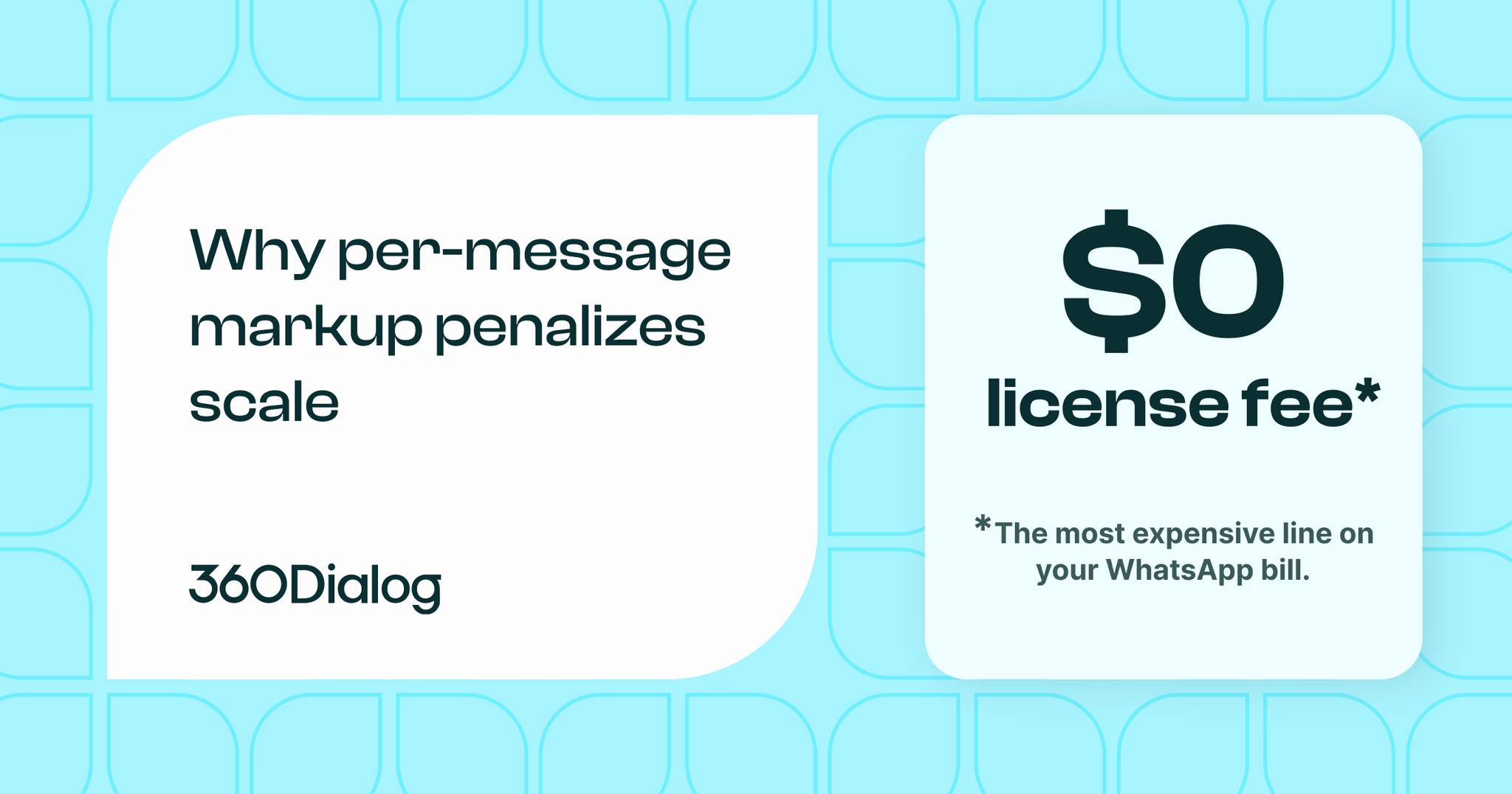
The End of the Transactional Era: Why 360Dialog’s Subscription Model is the Future of WhatsApp Business
To evaluate the shifting realities of WhatsApp ecosystem costs, it is essential to define how these competing structures operate. A subscription-based pricing model charges businesses a predictable, flat license fee at recurring intervals, entirely independent of the volume of messages transmitted. On the other hand, a transactional pricing model continuously charges companies a variable fee…
-
How to build WhatsApp Into Your SaaS
Your customers want to reach their own users on WhatsApp, and the ones who can’t do it inside your platform are doing it somewhere else. Every time a user leaves your product to send a message from another tool, that’s activity you no longer own, and activity that moves outside your platform is where stickiness…
Ready to explore what WhatsApp can do for your business?
From API access to managed campaigns, find the
approach that fits your needs.