
360Dialog banner asking "Is your BSP GDPR-ready?" beside a GDPR checklist with a verified shield, on WhatsApp GDPR compliance.

EU-Hosted WhatsApp: What GDPR Actually Means for Your BSP in 2026

For years, choosing a WhatsApp provider was mostly a messaging decision. In 2026, it has turned into a data-protection one. Legal, procurement, and security teams across Europe are asking harder questions about where customer conversations are processed and stored, and who can reach that data. For banks, insurers, hospitals, public bodies, and SaaS platforms handling personal data at scale, WhatsApp GDPR compliance now sits on the same desk as vendor risk and audit readiness.

Why the WhatsApp GDPR Conversation Changed in 2026

The text of GDPR is the same as it was five years ago. What moved is regulatory enforcement, supervisory guidance, and practical interpretation of the rules. Regulators that spent the early years developing guidance and building case law are now issuing decisions, and the biggest ones land on the exact thing WhatsApp buyers used to gloss over: where data goes once it leaves the app.


In May 2023, the Irish Data Protection Commission fined Meta € 1.2 billion in relation to transfers of European users’ personal data to the United States in connection with Facebook services and ordered it to stop those transfers until compliance requirements were met. There was no leak and no breach behind that number. The transfer mechanism itself, moving EU data to US servers, had been ruled unlawful in that specific context following the Schrems II judgment 

The decision reinforced the wider GDPR principle that organizations relying on international transfers must assess transfer risks and implement appropriate safeguards.Any company routing customer data through US-controlled infrastructure now carries a price tag for getting it wrong, with GDPR fines reaching up to 20 million euros or 4 percent of global annual turnover.


A Solution Partner evaluation today reflects that. Meta has retired the label Business Solution Provider (BSP); these partners are now officially called Solution Partners. That evaluation runs well past consent banners and privacy policies, and procurement wants specifics:

  • Where the infrastructure physically runs
  • Which subprocessors touch the data
  • Which legal system can compel access to it
  • How cross-border transfers are structured


Those answers are where WhatsApp GDPR compliance is actually decided.

Where Your GDPR Exposure Actually Sits

No serious regulator treats WhatsApp as automatically non-compliant. What determines your exposure is the architecture around it. Two companies can run identical WhatsApp campaigns and land in very different risk positions, depending on where their Solution Partner hosts data, how it routes messages, which subprocessors it uses, and where it keeps its logs.


In regulated sectors, that architecture question is exactly what puts the EU-hosted WhatsApp Business API on the table. Keeping application data and processing inside the European Economic Area shrinks the part of your setup a transfer assessment has to cover. GDPR obligations still apply either way, and the hardest question in the whole review, what happens to this data once it leaves the EU, simply stops being one you have to answer.

WhatsApp GDPR Compliance Comes Down to Data Flow

Most teams underestimate how detailed a modern GDPR review has become. Ever since Schrems II, the 2020 ruling that struck down the EU-US Privacy Shield, European supervisory authorities have expected organizations to map their data flows in real detail:

  • Where message metadata travels
  • Where application logs are written
  • Which systems process customer identifiers
  • Whether anything leaves the EU during routing or support


A lot of Solution Partner claims fall apart at this stage. A provider can call itself “European-friendly” and still run logging, support tooling, or fallback processing on non-EU systems. It can pass a surface check and fail the moment someone runs a data protection impact assessment against it.

WhatsApp data residency has gone from a legal footnote to something you can be asked to prove: where does this data live, and who can reach it? That question gets sharper the moment WhatsApp moves from a marketing channel into onboarding and support through the WhatsApp API, where it handles personal data all day.

Application Usage Versus Infrastructure Control

The gap most buyers miss sits between using an application and controlling the infrastructure under it. A messaging platform can look clean at the interface and still expose you underneath. Messages might be encrypted end to end while operational metadata crosses US systems, logs sit in a non-EU region, or a support engineer reaches the data from a third country. Security protections alone do not answer all GDPR questions, because organizations must also assess processing locations, access controls, subprocessors and applicable jurisdictions. A product demo will never surface any of that. It comes out later, when legal traces where the data actually goes.

EU-Hosted vs Global Hosting, in Practice

A traditional global setup is built for scale and convenience. It usually:

  • Spreads workloads across multiple regions
  • Replicates logs worldwide
  • Centralizes support in a single location
  • Defaults to US processing

For plenty of use cases that works well. For regulated data, it hands you a long list of transfers you then have to justify. An EU-hosted WhatsApp Business API environment works the other way around: processing stays in an EU region, storage stays local, transfers are kept to a minimum, and controls are set per region.This does not remove all GDPR obligations. Organizations still need to review DPAs, subprocessors, access controls and any remaining international processing activities. You still sign a DPA and still run your assessments. The surface area you are defending is smaller, and the review moves faster because there is less to explain.

The CLOUD Act and Extraterritorial Access

European buyers keep circling back to one question: who actually owns the infrastructure. Under the US CLOUD Act, passed in 2018, a US-based provider can be compelled to hand over data it controls even when that data is stored abroad. The risk here is jurisdictional. Even a company you completely trust can be served with a US legal order and have to comply.

For a bank or a hospital, that opens a line of questions a sales deck cannot settle: whether the data can be demanded at all, what metadata falls under that reach, and what actually stands between a US court order and European customer records. Hosting location and infrastructure ownership have stopped being secondary details as a result, and CLOUD Act WhatsApp exposure now shows up as a standard line item in serious vendor reviews.

Documentation Over Marketing Claims

“GDPR-ready”, “privacy-focused”, “enterprise secure” – every provider offers some version of these. Procurement teams have learned to look past the labels and ask for the documentation:

  • A real subprocessor list
  • Documentation of where deployment actually happens
  • Contractual processing terms they can hold the provider to


The document that carries the most weight is the WhatsApp DPA. The Data Processing Addendum used to be an attachment nobody opened. Now it gets marked up like a contract, because it sets out who is responsible for what, how transfers are handled, when you get told about a breach, and what the processor is allowed to do with the data. Teams in 2026 read it far more closely than they did three years ago, and they notice when it is vague.
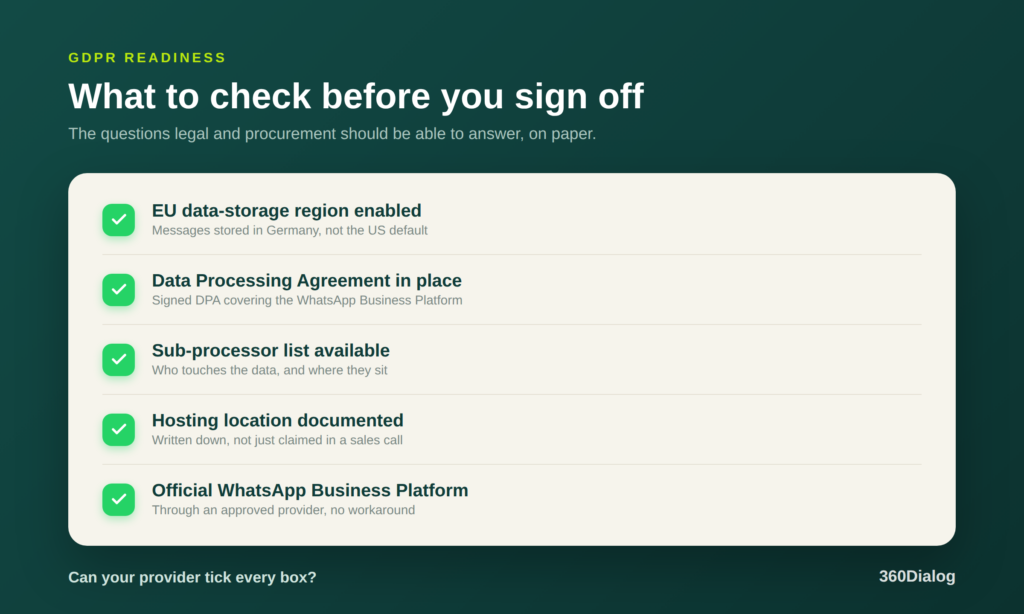
GDPR readiness checklist for a WhatsApp Business Platform provider: EU data-storage region enabled, Data Processing Agreement, sub-processor list, documented hosting location, and official WhatsApp Business Platform.

Why Regulated Industries Move First

The pressure is heaviest where the conversation itself is sensitive: a bank onboarding a customer, a clinic confirming an appointment, an insurer handling a claim, a public agency dealing with citizens. In those settings, WhatsApp becomes part of the governance stack, and a weak hosting story creates real friction.

Procurement stalls, legal escalates, a DPIA gets reopened, security pushes back. So the buyers with the most to lose are the ones adopting region-specific infrastructure fastest. Clean, EU-based reporting through your WhatsApp analytics and governance tooling helps too, once auditors start asking for evidence instead of assurances.

Compliance Is Becoming a Marketplace Decision

One of the clearer shifts this year is who sits in the room for a Solution Partner decision. It used to be security. Now procurement, legal, operations, and sometimes the executive team all weigh in, because messaging infrastructure feeds straight into enterprise risk.

That has reshaped how the WhatsApp Marketplace competes. Uptime and onboarding speed still matter, but they no longer win a deal on their own. Buyers now compare providers on infrastructure transparency, hosting jurisdiction, and whether the whole setup can be defended in front of a regulator.

From “Compliant” to “Defensible”

There is a real difference between clearing a compliance checkbox and being able to defend your setup when someone pushes on it. Defensible means you can show, on request:

  • Where your data actually is
  • That you have assessed the transfer risk
  • That your vendor is accountable in writing
  • That your processing logic is documented rather than assumed


That is a higher bar, and it only holds when legal, infrastructure, procurement, security, and the people running the messaging program are actually talking to each other. The companies that manage it treat WhatsApp infrastructure as part of their governance, the same way they treat any other system that handles customer data.

Where 360Dialog Fits Into This Shift

360Dialog built its infrastructure strategy around exactly this environment, across two layers. Its own platform infrastructure (the dashboard, webhook processing, and support tooling) runs on Google Cloud in the EU region. The message data itself sits on Meta’s Cloud API, which defaults to a US region unless you configure an EU data-storage region such as Germany. With the EU region selected, this becomes an EU-hosted WhatsApp Business Platform setup that legal and procurement can sign off without a long list of caveats.
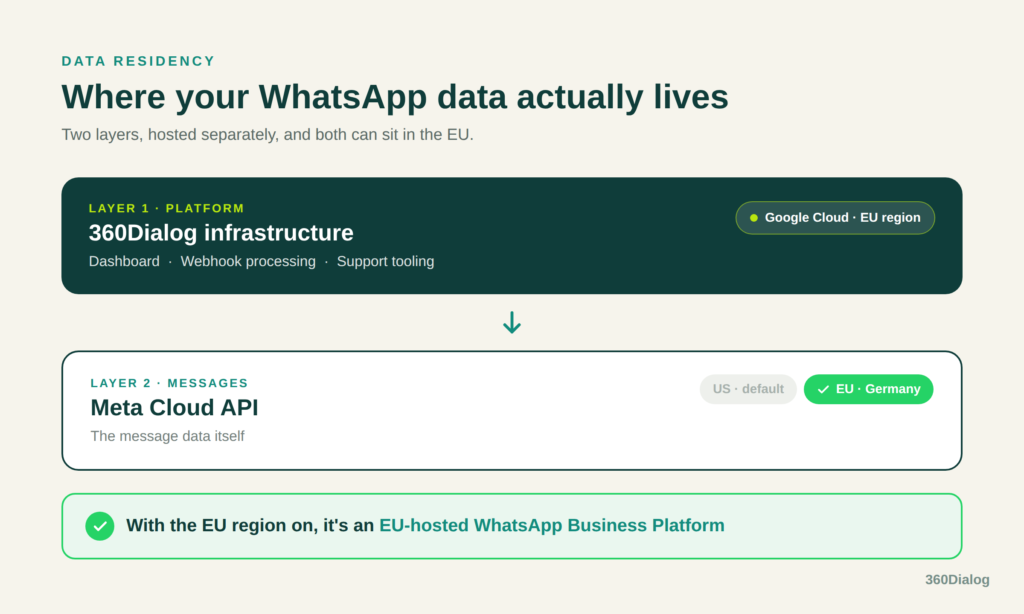
Diagram of 360Dialog's two-layer hosting: platform infrastructure on Google Cloud EU region and WhatsApp message data on Meta Cloud API set to the EU (Germany) data-storage region, forming an EU-hosted WhatsApp Business Platform.

Where This Becomes a Commercial Advantage

Given enough time, this stops being only a compliance story and becomes a sales one. A provider that can show EU-based infrastructure, a short transfer list, and clean documentation moves through procurement faster, because there is less for legal to argue about. One leaning on opaque global infrastructure gets longer reviews, heavier due diligence, and deals that stall in security.

As WhatsApp becomes core infrastructure for onboarding and support, EU hosting stops being a nice-to-have and becomes part of how the WhatsApp GDPR compliance 2026 conversation gets settled inside regulated companies.

What It Comes Down To

In regulated industries, the providers that win are the ones that can explain their infrastructure plainly, show where data goes, and answer the jurisdiction question before a regulator or procurement lead has to ask it. That capability, more than any privacy slogan, is what carries a vendor through review in 2026, while the rest stay stuck in it.

FAQ

How should we evaluate a Solution Partner for GDPR risk?

Start with the hosting jurisdiction and the subprocessor list, then work through infrastructure transparency, transfer mechanisms, access controls, and what the contract actually commits the provider to. If a provider cannot produce those, you have your answer.


Why does EU hosting matter so much for WhatsApp?

An EU-hosted WhatsApp Business API keeps more of your data and processing inside the EEA, which shrinks your transfer exposure and makes regulatory assessments faster to pass.


Does GDPR require WhatsApp data to stay inside the EU?

Not in so many words. GDPR governs how transfers are done, what safeguards apply, and who is accountable, rather than banning transfers outright. Keeping data in the EU simply removes the hardest part of the assessment.


Is encryption enough on its own?

No. Encryption protects data in transit and at rest, while GDPR also weighs governance, where the infrastructure sits, which jurisdiction applies, and whether your processor is accountable.

For years, choosing a WhatsApp provider was mostly a messaging decision. In 2026, it has turned into a data-protection one. Legal, procurement, and security teams across Europe are asking harder questions about where customer conversations are processed and stored, and who can reach that data. For banks, insurers, hospitals, public bodies, and SaaS platforms handling personal data at scale, WhatsApp GDPR compliance now sits on the same desk as vendor risk and audit readiness.

Why the WhatsApp GDPR Conversation Changed in 2026

The text of GDPR is the same as it was five years ago. What moved is regulatory enforcement, supervisory guidance, and practical interpretation of the rules. Regulators that spent the early years developing guidance and building case law are now issuing decisions, and the biggest ones land on the exact thing WhatsApp buyers used to gloss over: where data goes once it leaves the app.


In May 2023, the Irish Data Protection Commission fined Meta € 1.2 billion in relation to transfers of European users’ personal data to the United States in connection with Facebook services and ordered it to stop those transfers until compliance requirements were met. There was no leak and no breach behind that number. The transfer mechanism itself, moving EU data to US servers, had been ruled unlawful in that specific context following the Schrems II judgment 

The decision reinforced the wider GDPR principle that organizations relying on international transfers must assess transfer risks and implement appropriate safeguards.Any company routing customer data through US-controlled infrastructure now carries a price tag for getting it wrong, with GDPR fines reaching up to 20 million euros or 4 percent of global annual turnover.


A Solution Partner evaluation today reflects that. Meta has retired the label Business Solution Provider (BSP); these partners are now officially called Solution Partners. That evaluation runs well past consent banners and privacy policies, and procurement wants specifics:

  • Where the infrastructure physically runs
  • Which subprocessors touch the data
  • Which legal system can compel access to it
  • How cross-border transfers are structured


Those answers are where WhatsApp GDPR compliance is actually decided.

Where Your GDPR Exposure Actually Sits

No serious regulator treats WhatsApp as automatically non-compliant. What determines your exposure is the architecture around it. Two companies can run identical WhatsApp campaigns and land in very different risk positions, depending on where their Solution Partner hosts data, how it routes messages, which subprocessors it uses, and where it keeps its logs.


In regulated sectors, that architecture question is exactly what puts the EU-hosted WhatsApp Business API on the table. Keeping application data and processing inside the European Economic Area shrinks the part of your setup a transfer assessment has to cover. GDPR obligations still apply either way, and the hardest question in the whole review, what happens to this data once it leaves the EU, simply stops being one you have to answer.

WhatsApp GDPR Compliance Comes Down to Data Flow

Most teams underestimate how detailed a modern GDPR review has become. Ever since Schrems II, the 2020 ruling that struck down the EU-US Privacy Shield, European supervisory authorities have expected organizations to map their data flows in real detail:

  • Where message metadata travels
  • Where application logs are written
  • Which systems process customer identifiers
  • Whether anything leaves the EU during routing or support


A lot of Solution Partner claims fall apart at this stage. A provider can call itself “European-friendly” and still run logging, support tooling, or fallback processing on non-EU systems. It can pass a surface check and fail the moment someone runs a data protection impact assessment against it.

WhatsApp data residency has gone from a legal footnote to something you can be asked to prove: where does this data live, and who can reach it? That question gets sharper the moment WhatsApp moves from a marketing channel into onboarding and support through the WhatsApp API, where it handles personal data all day.

Application Usage Versus Infrastructure Control

The gap most buyers miss sits between using an application and controlling the infrastructure under it. A messaging platform can look clean at the interface and still expose you underneath. Messages might be encrypted end to end while operational metadata crosses US systems, logs sit in a non-EU region, or a support engineer reaches the data from a third country. Security protections alone do not answer all GDPR questions, because organizations must also assess processing locations, access controls, subprocessors and applicable jurisdictions. A product demo will never surface any of that. It comes out later, when legal traces where the data actually goes.

EU-Hosted vs Global Hosting, in Practice

A traditional global setup is built for scale and convenience. It usually:

  • Spreads workloads across multiple regions
  • Replicates logs worldwide
  • Centralizes support in a single location
  • Defaults to US processing

For plenty of use cases that works well. For regulated data, it hands you a long list of transfers you then have to justify. An EU-hosted WhatsApp Business API environment works the other way around: processing stays in an EU region, storage stays local, transfers are kept to a minimum, and controls are set per region.This does not remove all GDPR obligations. Organizations still need to review DPAs, subprocessors, access controls and any remaining international processing activities. You still sign a DPA and still run your assessments. The surface area you are defending is smaller, and the review moves faster because there is less to explain.

The CLOUD Act and Extraterritorial Access

European buyers keep circling back to one question: who actually owns the infrastructure. Under the US CLOUD Act, passed in 2018, a US-based provider can be compelled to hand over data it controls even when that data is stored abroad. The risk here is jurisdictional. Even a company you completely trust can be served with a US legal order and have to comply.

For a bank or a hospital, that opens a line of questions a sales deck cannot settle: whether the data can be demanded at all, what metadata falls under that reach, and what actually stands between a US court order and European customer records. Hosting location and infrastructure ownership have stopped being secondary details as a result, and CLOUD Act WhatsApp exposure now shows up as a standard line item in serious vendor reviews.

Documentation Over Marketing Claims

“GDPR-ready”, “privacy-focused”, “enterprise secure” – every provider offers some version of these. Procurement teams have learned to look past the labels and ask for the documentation:

  • A real subprocessor list
  • Documentation of where deployment actually happens
  • Contractual processing terms they can hold the provider to


The document that carries the most weight is the WhatsApp DPA. The Data Processing Addendum used to be an attachment nobody opened. Now it gets marked up like a contract, because it sets out who is responsible for what, how transfers are handled, when you get told about a breach, and what the processor is allowed to do with the data. Teams in 2026 read it far more closely than they did three years ago, and they notice when it is vague.

GDPR readiness checklist for a WhatsApp Business Platform provider: EU data-storage region enabled, Data Processing Agreement, sub-processor list, documented hosting location, and official WhatsApp Business Platform.

Why Regulated Industries Move First

The pressure is heaviest where the conversation itself is sensitive: a bank onboarding a customer, a clinic confirming an appointment, an insurer handling a claim, a public agency dealing with citizens. In those settings, WhatsApp becomes part of the governance stack, and a weak hosting story creates real friction.

Procurement stalls, legal escalates, a DPIA gets reopened, security pushes back. So the buyers with the most to lose are the ones adopting region-specific infrastructure fastest. Clean, EU-based reporting through your WhatsApp analytics and governance tooling helps too, once auditors start asking for evidence instead of assurances.

Compliance Is Becoming a Marketplace Decision

One of the clearer shifts this year is who sits in the room for a Solution Partner decision. It used to be security. Now procurement, legal, operations, and sometimes the executive team all weigh in, because messaging infrastructure feeds straight into enterprise risk.

That has reshaped how the WhatsApp Marketplace competes. Uptime and onboarding speed still matter, but they no longer win a deal on their own. Buyers now compare providers on infrastructure transparency, hosting jurisdiction, and whether the whole setup can be defended in front of a regulator.

From “Compliant” to “Defensible”

There is a real difference between clearing a compliance checkbox and being able to defend your setup when someone pushes on it. Defensible means you can show, on request:

  • Where your data actually is
  • That you have assessed the transfer risk
  • That your vendor is accountable in writing
  • That your processing logic is documented rather than assumed


That is a higher bar, and it only holds when legal, infrastructure, procurement, security, and the people running the messaging program are actually talking to each other. The companies that manage it treat WhatsApp infrastructure as part of their governance, the same way they treat any other system that handles customer data.

Where 360Dialog Fits Into This Shift

360Dialog built its infrastructure strategy around exactly this environment, across two layers. Its own platform infrastructure (the dashboard, webhook processing, and support tooling) runs on Google Cloud in the EU region. The message data itself sits on Meta’s Cloud API, which defaults to a US region unless you configure an EU data-storage region such as Germany. With the EU region selected, this becomes an EU-hosted WhatsApp Business Platform setup that legal and procurement can sign off without a long list of caveats.

Diagram of 360Dialog's two-layer hosting: platform infrastructure on Google Cloud EU region and WhatsApp message data on Meta Cloud API set to the EU (Germany) data-storage region, forming an EU-hosted WhatsApp Business Platform.

Where This Becomes a Commercial Advantage

Given enough time, this stops being only a compliance story and becomes a sales one. A provider that can show EU-based infrastructure, a short transfer list, and clean documentation moves through procurement faster, because there is less for legal to argue about. One leaning on opaque global infrastructure gets longer reviews, heavier due diligence, and deals that stall in security.

As WhatsApp becomes core infrastructure for onboarding and support, EU hosting stops being a nice-to-have and becomes part of how the WhatsApp GDPR compliance 2026 conversation gets settled inside regulated companies.

What It Comes Down To

In regulated industries, the providers that win are the ones that can explain their infrastructure plainly, show where data goes, and answer the jurisdiction question before a regulator or procurement lead has to ask it. That capability, more than any privacy slogan, is what carries a vendor through review in 2026, while the rest stay stuck in it.

FAQ

How should we evaluate a Solution Partner for GDPR risk?

Start with the hosting jurisdiction and the subprocessor list, then work through infrastructure transparency, transfer mechanisms, access controls, and what the contract actually commits the provider to. If a provider cannot produce those, you have your answer.


Why does EU hosting matter so much for WhatsApp?

An EU-hosted WhatsApp Business API keeps more of your data and processing inside the EEA, which shrinks your transfer exposure and makes regulatory assessments faster to pass.


Does GDPR require WhatsApp data to stay inside the EU?

Not in so many words. GDPR governs how transfers are done, what safeguards apply, and who is accountable, rather than banning transfers outright. Keeping data in the EU simply removes the hardest part of the assessment.


Is encryption enough on its own?

No. Encryption protects data in transit and at rest, while GDPR also weighs governance, where the infrastructure sits, which jurisdiction applies, and whether your processor is accountable.